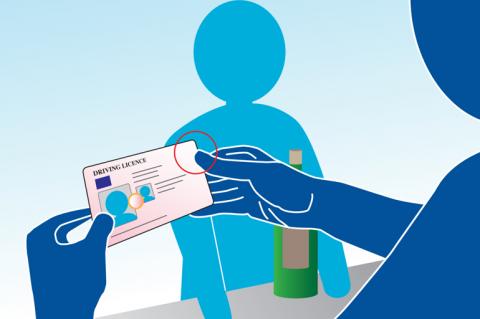
This week the government has announced that it will introduce digital driving licenses. There are lots of interesting and important questions dominating most of the public debate on this, for example about the other government services that will be accessed through the same system, about the benefits to those (including employers, which is relevant to us) who might use the new system to get information they need, and about how British people feel about anything that looks and feels like an ID card. I want to park all of that and focus on one thing: how will a digital driving licence be used to help people prove they are old enough to buy age-restricted products?
I start addressing this question from the operational basics. When an ACS member or their colleague is selling an age-restricted product (and there are a lot of them, check here for the full list) they need to know a) whether they can accept digital proof of age, b) which digital and physical proof of age schemes can be used, and c) how to check that the proof is valid and the person buying the product is the rightful holder of that proof. If retailers are confident on those three things, they can make sure they don’t sell to people too young to buy, make sure they do make all the legal sales customers want, and know they will be trading lawfully.
So can you accept digital proof of age? Yes, and from later this year you’ll be able to do this for alcohol as well. Check our guidance for details on how to do this, and you’ll see that’s there’s not a straightforward, universal system in place yet.
Which digital proof of age schemes can your customers use in your store? Well at the moment it’s the ones where you have an agreement in place with digital proof of age issuer to do so. That’s fine but it’s not scalable: if there are twenty different digital proof of age schemes issuers, are you going to programme your systems and train your colleagues on twenty different systems to accept these? Of course not. This is where the PASS scheme comes in. This not-for-profit body was formed in 2001 to set standards for proof of age, the security features of that proof of age and the process for accepting it. Back then it was all about plastic cards and deciding which were robust enough to add the PASS hologram.
The challenge now is to determine which digital proofs can be accepted, and PASS has standards in place for that. The government is playing a role too by establishing (and you could be forgiven for getting a bit caught up in the jargon here) the Digital Identity & Attributes Trust Framework. These standards, overseen by a new regulator OfDIA, set out what makes digital ID reliable and trustworthy, and remember that digital ID is used for far more than buying products in shops, there’s a whole host of online services and legal processes that these can support.
So to the final, and crucial question for retailers. How do you check digital proof of age in store? With a physical proof of age card, all the security features are there to inspect, notably the PASS hologram and thermally-integrated picture (no edges or bumps). It’s more complex with digital proof of age because what you could be shown on the screen could have been doctored in any number of ways; there needs to be a digital “handshake” between the retailer and the customer to verify its validity. Thankfully PASS now has a system ready to go to do exactly this job. Two quick scans and the proof of age can be verified with minimal data transfer – you only need to know if that person is old enough to buy the product they want, you don’t need to see their address much less get into the ramifications of holding customer information.
Three out of three then: retailers can accept digital proof of age, they can know which proofs to accept, and they can validate them quickly and securely in store. Two big challenges for now then: getting the digital driving licence on board with that system, and promoting a common approach among regulatory bodies and businesses accepting proof of age. There’s a big prize here and I think that PASS’s solution is the best way to claim it.
I’ve deliberately focused very narrowly on the bare bones of legal and operational compliance, but there’s another massive opportunity probably for another blog: getting the use of digital proof of age right and combining it with effective use of age estimation technology would bring huge savings to retailers using self-service checkouts. Customers over 25 could breeze through without age checks, those under could prove their age to the till, with colleagues playing an oversight role. Furthermore, technology playing a greater role in determining customers’ age will reduce the number of times a colleague challenges a customer, something we know causes friction, conflict and even violence on a daily basis.
Digital proof of age, including a digital driving licence, offers real benefits for local shops. We need to stay at the centre of discussions on how this is used in stores so that we can fully realise these.
*James represents ACS on the board of PASS, and has chaired working groups developing digital proof of age standards and acceptance systems over the past five years.