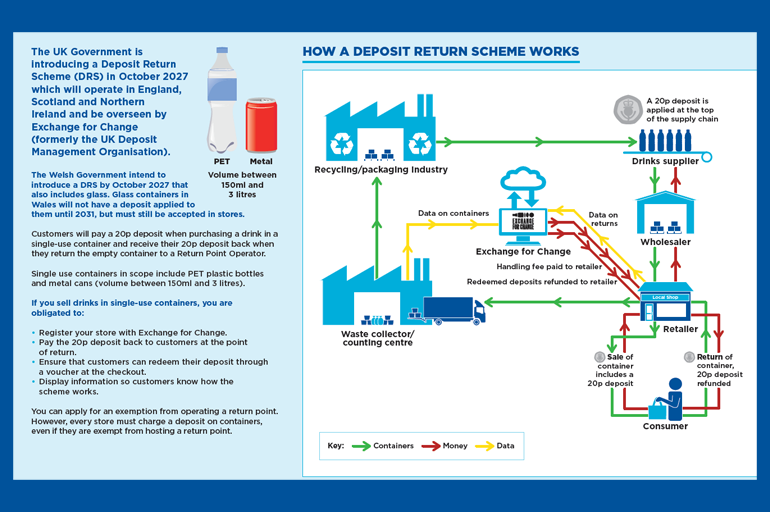
In October 2027, the UK Government will introduce a Deposit Return Scheme (DRS) for PET plastic bottles and metal cans. The UK scheme will apply in England, Scotland and Northern Ireland, with Wales looking to introduce a similar scheme focused more on reuse that also includes glass. For the purposes of this guidance, we will refer primarily to the UK scheme unless otherwise specified.
ACS has put together detailed guidance for retailers on the operation of the scheme, including information on the different types of return point, exemption criteria, collection of containers and more.
ACS Deposit Return Scheme Guide: June 2026 Update
Keep Up to Date with the Latest on DRS
The ACS DRS Guide will be updated regularly as more details are confirmed about the scheme.
If you would like to be added to a mailing list notifying you of updates to the latest version of the guide, please email enter your details below.
In this resources centre, we aim to provide you with all the information you need to make an informed decision about how your business will be involved with the Deposit Return Scheme. If you have any questions about the scheme that we haven't covered yet, please get in touch with us via email at [email protected].
Glossary of Terms
There are a lot of words and phrases associated with DRS that can be hard to get to grips with. Some of the most used acronyms and their definitions are below - we've also produced a wider glossary of terms to help retailers understand all the different areas of DRS operations.
Download the DRS Glossary of Terms here
DMO stands for Deposit Management Organisation. This is the organisation that is appointed by the Government to oversee the scheme.
DRS stands for Deposit Return Scheme.
HDPE stands for High-Density Polyethylene, which is typically what milk bottles are made from. HDPE containers are not in scope of the scheme.
EFC stands for Exchange for Change, who are the organisation appointed as the Deposit Management Organisation to run the scheme in England, Scotland and Northern Ireland.
PET stands for Polyethylene Terephthalate, which is a strong, lightweight plastic commonly used for drinks packaging.
RHF stands for retail handing fee. This is the compensation that a retailer receives to cover the costs associated with collecting containers. The RHF will be paid per container returned to the business.
RVM stands for reverse vending machine. This is a machine that allows customers to return their containers and collect their deposit vouchers through an automated process.
DRS: The Basics
Who is running the scheme?
The scheme in England, Scotland and Northern Ireland is being administered by Exchange for Change who have been appointed as the Deposit Management Organisation. Exchange for Change, in consultation with retailers and producers, are responsible for making the logistics of the scheme work in practice, as well as setting the deposit levels and retail handling fees that retailers receive for being involved in the scheme.
To date, Wales has not yet appointed a Deposit Management Organisation to run its scheme despite seeking to introduce the scheme within the same timeframes as the rest of the UK.
Which containers are in scope?
Drinks containers with a volume between 150ml and 3 litres that are either made from PET plastic or metal will be in scope and have a 20p deposit charged on them.
The Welsh Government intends to include glass within its scheme, and have laid its own regulations, although details of how this will work have not yet been confirmed.
How much extra will customers pay for containers in scope?
Exchange for Change have confirmed that a deposit amount of 20p will be charged on every container that is in scope of the regulations, which consumers will get back when they return those containers either through a reverse vending machine or to a manual return point. The 20p deposit applies to each container, so for example the total deposit amount for a multipack of six cans would be £1.20 (6 x 20p).
How much will retailers get paid for taking back containers?
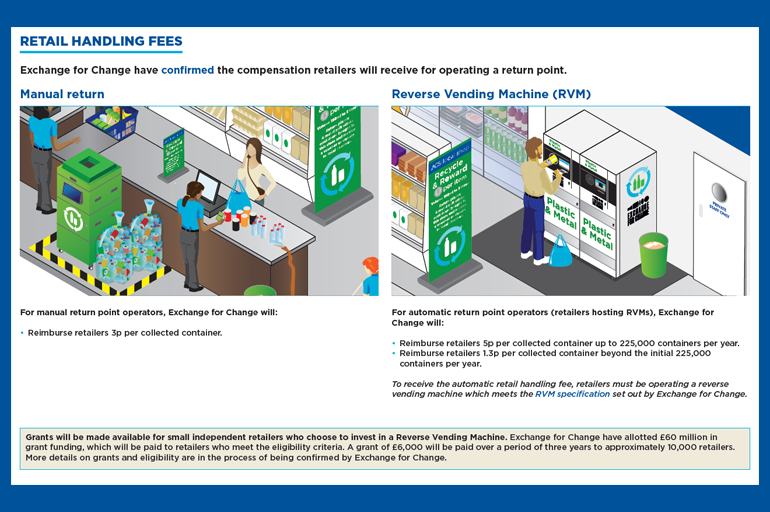
The amount that retailers receive for taking back containers depends on a number of factors, including the volume of containers that they take back and whether they're taking back containers manually or via a reverse vending machine (RVM). This amount is called the retail handling fee (RHF). A breakdown of the retail handling fees that will be paid to retailers is below:
- Manual returns: 3p per container
- Reverse vending machine (first 225,000 containers each year): 5p per container
- Reverse vending machine (additional containers after first 225,000 each year): 1.3p per container
Will everyone have to be part of the scheme?
Every retailer who sells containers that are in scope of the regulations will have to register with Exchange for Change and charge the 20p deposit on those containers.
There are three options for retailers when it comes to the return of containers:
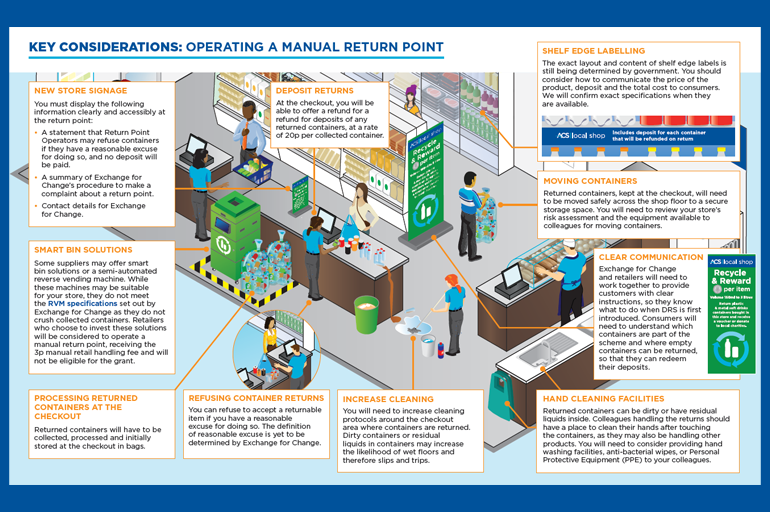
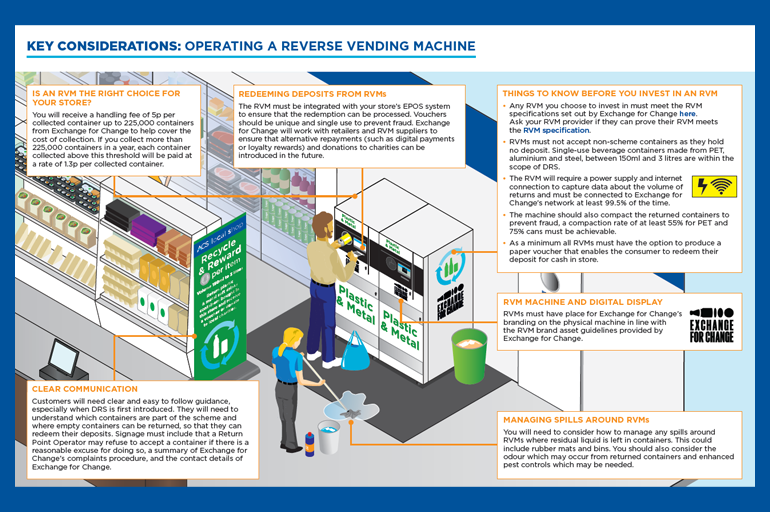
Reverse vending machine: This is a machine that enables customers to return their containers without the involvement of colleagues (in theory). Customers put their containers into the machine, they're then scanned and compacted, with deposits being refunded via a voucher that is printed out.
Manual return point: This is an option that allows colleagues to collect and scan returned containers at the checkout and then refund deposits based on how many containers are collected. When operating a manual return point, the containers must not be crushed or compacted, as they will need to be scanned again once collected and sent to a recycling depot.
Exemption: Some stores will be exempt from hosting a return point. If you operate a small store (under 100 sq m) in an urban area, you'll be automatically exempt from hosting a return point, but you can still apply to be a voluntary return point if you choose to do so. Other exemptions might be available to you if you don't believe that hosting a return point is feasible for your business. You will still need to register your store as a potential return point while Exchange for Change access your exemption application.
Is there any extra support available for retailers?
Exchange for Change have put aside £60m to fund grants for some small independent businesses who choose to operate an automatic return point. Grants of £6,000 will be delivered over a three year period at £2,000 per year to support the purchase of a Reverse Vending Machine (RVM).
Further information about how to apply for a grant is being confirmed. We will signpost this information once it becomes available.
How do I get a reverse vending machine?
There are a number of companies that will supply Reverse Vending Machines to the UK market. Some of those companies are part of ACS' Premier Club package, with more details about those companies and further information available below:
- TOMRA is a leading providing of reverse vending technology for deposit return schemes around the world. With over 50 years’ experience and approximately 91,000 installations across more than 60 markets, TOMRA reverse vending machines capture over 53 billion used bottles and cans each year. The company has deep knowledge of deposit return schemes around the world, including Germany, Norway, Romania and Ireland, and is ready to support convenience retailers across the UK as they prepare for the upcoming UK DRS.
- Envipco is a global leader in reverse vending machine (RVM) technology, helping businesses, governments, and communities turn empty bottles and cans into a cleaner future. Our smart recycling solutions – from compact machines for small retailers to large-scale systems for supermarkets and large collection centers, make deposit return schemes (DRS) seamless, efficient, and rewarding.
- RVM Systems is a Swedish family-owned company specialising in reverse vending machines and complete solutions for Deposit Return Systems (DRS). We design, manufacture, install and service return technology for retailers, hospitality and public spaces across Europe. We deliver end-to-end reverse vending solutions, from hardware and software to installation, maintenance and integration with DRS administrator. One partner. Full chain. No gaps.
Experiences from Vienna: DRS One Year On
Retailers in Vienna introduced a Deposit Return Scheme in 2025 and have been learning from the first year of the scheme to make it as efficient as possible. We visited some stores in Vienna as part of our European Study Tour in May this year to talk to retailers that have been responsible for running the scheme, asking about their experience in the 12 months that the scheme has been in place so far.
Watch the video of our chief executive Ed Woodall talking to retailers in Vienna about DRS below, and check out our summary of five things that we learned from the discussion:

Customers prefer RVMs over manual processes. We heard that customers liked the way that RVMs work and the automated processing of their deposit refunds much more than a manual process where containers need to be scanned across the till point and then bagged/stored by colleagues.
Ease of customer engagement has been prioritised over store operations when placing an RVM inside of stores. In Vienna, the machines are at the front of the store to make it as easy as possible for customers to come in and return bottles before doing their shopping. This is preferred to having the machines near a backroom entrance further into the store which would be easier for colleagues when emptying the machine, but more difficult for customers.
Stores made use of additional recycling points placed near RVMs. During the transition period, there will be a lot of containers which outside the scope of the scheme that consumers may try to return. It's important to have additional recycling facilities for these containers to avoid widespread littering and issues with the RVM.
High volume machines could be emptied up to 10 times a day. In some city centre locations and areas where there is very high footfall, we heard that the machine could need emptying every couple of hours, requiring significant staff time diverted to making this happen throughout the day.

RVMs need regular cleaning and maintenance for optimum performance. Some customers are going to come in with containers that haven't been cleaned, or aren't completely empty, so the RVMs can get clogged up very quickly. We heard that to avoid reliability issues with the RVM, it needs to be cleaned every day by store colleagues.
Beyond the Basics: Frequently Asked Questions
Throughout the process of the UK introducing a deposit return scheme, there will be a lot of questions about how the scheme works. We've put together answers to some of the most common questions about the scheme below, but if you have any additional questions that you'd like us to answer, just email us at [email protected] and we'll look into it for you.
How does the deposit work on multipacks?
The deposit is applied per collected container, for example if the multipack has 8 items, each of those will hold a 20p deposit, therefore the deposit for that product will become £1.60. There will need to be clear communication for the display of pricing on multipacks, ACS is working with officials to ensure that the display of the deposit can be consistently applied across product ranges.
If your store is under 100m2 in urban areas, it is automatically exempted from hosting a return point. Can you opt in?
Yes, any store can choose to host a voluntary return point, even if they are automatically exempt from the scheme. They would need to register with Exchange for Change to become a voluntary return point.
Will the retailer handling fee be reviewed periodically to ensure it remains in line with costs as they increase for retailers - particularly labour costs?
The Retail Handling Fee is set to be reviewed in Spring 2027, ahead of the scheme’s launch, and then annually going forward.
Can a Reverse Vending Machine (RVM) be placed outside (e.g. in the car park). Do you need planning permission for external machines?
It is best to check with the RVM supplier you choose to see if the machine is appropriately weatherproof or if it will need an external cover. In England and Scotland, there are permitted development rights for RVM’s hosted outdoors. RVM specifications are set out here by Exchange for Change.
What happens if my Reverse Vending Machine is not delivered by October 2027?
Your store will need to provide a manual takeback to ensure it is compliant with its return point obligations.
Are there going to be grants to support purchase of Reverse Vending Machines like in the Irish scheme?
Exchange for Change have announced that grants will be made available for small independent retailers. A grant of £6,000 will be paid over a three year period to up to 10,000 stores. More details on the grant application process are awaiting confirmation.
Who is the scheme administrator in Wales?
Exchange for Change are the scheme administrator for DRS in England, Scotland and Northern Ireland. The Welsh government have not yet appointed a Deposit Management Organisation to oversee DRS in Wales. We have been calling on the Welsh Government to appoint a DMO as soon as possible and align their scheme to that already in development in the rest of the UK.
How should the deposit be displayed?
The regulations currently set out that there are three elements retailers will need to display:
- Unit price
- Deposit
- Total price including deposit.
ACS is working with officials to remove the third element and simplify the display of price to ease administrative burden and prevent customer confusion.
How does the Retail Handling Fee work if I have a Reverse Vending Machine (RVM)?
Retailers who choose to invest in Reverse Vending Machine (RVM) will be reimbursed 5p per collected container up to 225,000 containers, and then 1.3p per container for the remainder of the year for each return point. If you have more than one store, it is only once that store’s return point reaches over 225,000 containers that the repayment tier will drop to 1.3p for that specific return point. The RVM must meet the requirements set out by Exchange for Change to qualify for this type handling payment.